

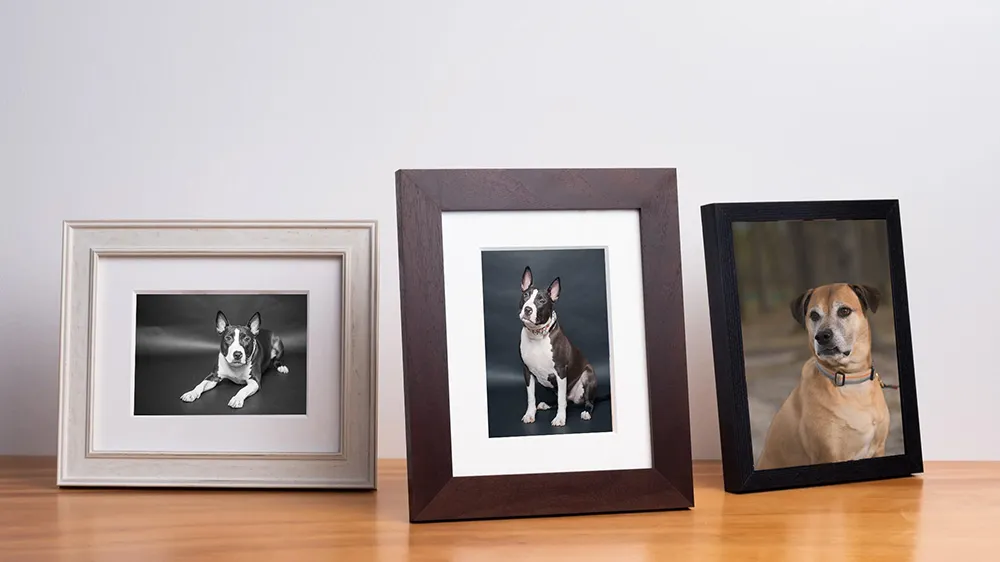
The most common mistake I see is a portrait that is too small.
It happens for understandable reasons. A print looks large in your hands. Then it goes up on the wall above an eight-foot sofa and suddenly it is floating there, a little lost, like a postage stamp on an envelope. The portrait is beautiful. The scale is wrong.
Size is not a technical detail. It decides whether a portrait becomes the heart of a room or something people walk past. Here is how I think about it with clients.
Start With the Wall, Not the Photo
Before choosing a size, look at what the portrait will live with. The furniture below it and the space around it matter more than the image itself.
Measure two things:
- The width of the furniture the portrait will hang above, such as a sofa, bed, console, or mantel.
- The open wall space you have, side to side and top to bottom.
If the portrait is going on a wall with nothing beneath it, like a hallway or stairwell, measure the full wall and think about where people will stand when they see it.
The Two-Thirds Rule
A helpful starting point used by interior designers: art above furniture should be roughly two-thirds the width of the piece below it.
Here is what that looks like in practice:
- A 7 to 8 foot sofa (84 to 96 inches) wants art about 56 to 64 inches wide. That might be one large canvas such as a 30 by 60, or a group of pieces that spans that width together.
- A queen bed (about 60 inches wide) suits art around 40 inches wide, such as a 30 by 40.
- A console table or dresser (about 48 inches) works well with a 24 by 36 or a 30 by 30.
It is a guideline, not a law. A tall, narrow wall might want a vertical piece that breaks the rule on purpose. But if you are unsure, start here and you will rarely end up with a portrait that feels lost.
How High to Hang It
Most people hang art too high. A good rule of thumb is to place the center of the portrait about 57 to 60 inches from the floor, which is roughly eye level for most adults.
Above furniture, leave about 8 to 10 inches between the top of the sofa or headboard and the bottom of the frame. Any more and the portrait stops feeling connected to the furniture beneath it.
You don't have to work any of this out yourself. Installation is part of every Hoof & Howl portrait. I measure, bring the hardware, and hang it.
One Large Piece or Several Smaller Ones?
Both work. They create different feelings.
A single large portrait is a statement. It works beautifully above a sofa or a fireplace, and it suits a portrait with real presence: a dog in full profile, or looking straight into the lens.
A group of portraits tells more of a story. One close portrait of the face, one of your dog in motion, one quiet moment asleep on the couch. Grouped together with even spacing, about 2 to 3 inches apart, they read as one piece of art and fill a wide wall without needing a single enormous canvas.
A pair works well in symmetrical spaces, like either side of a doorway, or above twin nightstands.
Matching Size to Format
The format you choose affects how size feels on the wall. For help choosing the format itself, see canvas, framed print, or Painter Portrait.
Gallery-wrapped canvas has no frame, so the image itself goes edge to edge. Canvas is available from small desk sizes up to large statement pieces, including long panoramic shapes like 12 by 36 and 20 by 60 that suit wide walls.
Heirloom framed prints add a frame and a mat, which makes the piece read larger than the image alone. A framed print also feels more formal, which suits libraries, offices, and traditional rooms.
Painter Portraits are printed as giclée canvas and reworked with digital brushstrokes. They look like traditional oil paintings, which makes them especially strong at larger sizes, where the texture has room to show.
Room by Room
Living room: this is where most centerpieces go. Above the sofa or the fireplace, go larger than you think. A 30 by 40 or larger is often right.
Bedroom: above the bed, a single wide piece or a pair. Softer, quieter portraits tend to suit this room.
Hallway or stairwell: a series of smaller pieces works well here, because people see them while moving.
Office or study: a framed print at eye level from your desk chair, or a portrait you can see from the doorway.
The Easiest Way to Decide: See It on Your Own Wall
Guidelines help, but nothing replaces seeing it. That is why every Hoof & Howl reveal shows your portraits to scale on your own walls before you choose a single piece. You can see how a 24 by 36 compares to a 30 by 40 above your actual sofa, in your actual light, before you decide.
If you'd like to know what the investment looks like, I keep a plain breakdown in how much pet portrait photography costs in New Jersey.
Frequently Asked Questions
What size canvas goes above a sofa?
Aim for about two-thirds of the sofa's width. For a typical 84 inch sofa, that is roughly 56 inches of art, either one large canvas or a grouping.
How high should a pet portrait hang?
Center it about 57 to 60 inches from the floor. Above furniture, leave 8 to 10 inches between the furniture and the bottom of the art.
Do you help choose the size?
Yes. We talk about your walls at the complimentary consultation, and at the reveal you see your portraits to scale on your own walls before choosing.
Do you hang the portraits?
Yes. Delivery and installation are included. I measure, bring the hardware, and hang it.
The Walls Are Waiting
If there is a wall in your home that has been waiting for the right piece, let's talk about it. Book your complimentary consultation, and if you like, bring a photo of the wall. You can also explore our wall art or read what to expect from a session.